
Hope your's has been full of treats and short on tricks.
Wednesday, October 31, 2007

frost

Fall has arrived. There has even been ice on the water troughs for the last three mornings. I guess I can finally safely plant the garlic.
Wednesday, October 24, 2007
Rain
We've had rain the last couple of days - most of it has been light and sporadic, but it's rain. There's a little over an inch in the rain gauge and perhaps more to come. The good news is that it seemed to rain heavier a little to the south of us - which could be good news for the Georgia lakes, which are so low.
If you haven't heard, Atlanta (a rather large city) has only 90 days of water left. There has finally been lots of discussion about water management processes. My only hope is that water management and city planners and citizens will take a good long look at long standing practices and change. My fear is that those planners and citizens will get over this crisis and go back to living like they always have. On a recent trip down to Georgia, I heard one person complain that they hadn't been able to go boating this summer. That was their biggest concern. How about drinking? Hmm.
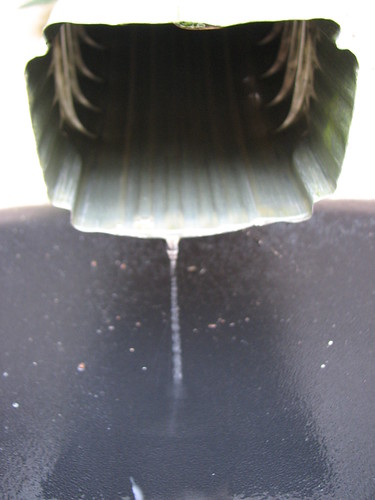
Our rain barrel will fill with about a 1/4 to 1/2 inch of rain - that's 65 gallons of water off of one small side of our roof. We've used ours to water the vegetable garden in the past, but this year I concentrated on using it to keep a bunch of young hydrangeas alive. And it worked. I placed a soaker hose on the spigot and let gravity force the water to slowly and conservatively water them. All are doing well. I don't think they would have survived without it. I put a pretty tight restriction on watering ornamentals over the summer, prefering to limit watering to the things we eat.
If you don't have a rain barrel or two, I encourage you to build or buy your own. Make it a project for the winter. You'll be able to use it in the spring to water all those seedlings.
Monday, October 15, 2007
No water
The well pump died yesterday. No water, not a trickle to be had. We've been waiting all day for the well men to squeeze us in and hooray! the cavalry has arrived! There's a lot of pipe running down our driveway and some rewiring going on. Hopefully soon we will have water again. The good news is that there is water in the well*. I was a little worried as Little Creek is just a faint trickle and the three springs on the property are mere mud pits at the moment. But the water is there and the machinery that brings it to us will be repaired (keeping fingers firmly crossed) and we'll be bathing, watering the animals and making ice soon.
*The well men say there are a lot of wells going dry. I couldn't imagine. What would we do with all the animals? I mean I can drink bottled water and shower at the YMCA, but I think they would frown on a gaggle of geese and a couple of feisty goats. Keep rainy thoughts in your hearts for us, please.
Tuesday, October 09, 2007
Jesus ate local...

I mean that in a very tongue in cheek way, so don't get offended (but, it's true). As part of another program at the Cathedral, we organized a 'meal of conscience' for our monthly family dinner. Out with the spaghetti, in with the brats and a little local beer. It's time for Octoberfest! Almost all the food served last Wednesday came from local sources. The bratwurst came from Spring House Meats at Hickory Nut Gap Farm . A big thank you to Jamie Ager of said farm for helping us with the vast quantity of sausage. Everyone thought they were the best bratwurst ever eaten. And there are quite a few Northerners in the mix, so that is a complement. Charlie and I made roasted potatoes and peppers, coleslaw (both with produc grown in the area) and baked beans (not quite local, but baked to perfection). Beer came from several local breweries, depending on personal taste. We have lots of local breweries in Asheville, so if you can't find a beer you like, well you must not like beer...
The crowd for this particular dinner was double the normal spaghetti supper crowd - around 150 people. We fed them all and had a few leftovers. The amazing thing was that it cost less per person to feed locally grown, organic, and humanely-raised food than it normally does to feed everyone spaghetti made with processed products bought at Sam's. It was a simple lesson to all present.
The most gratifying thing is that from this simple meal a whole discussion began. We Episcopalians are good at discussing. It's a particular talent of ours. It was decided that there should be a whole series of lessons on what it means to live in a conscience way - how as Christians, can we respect and protect the world around us. So, now there will be Sunday formation classes devoted to a whole range of topics (even food and farming!).
And wonder of wonder, a promise came to me, through Charlie, that the flowers will be fair trade, organic, and maybe even local. It's been my pet peeve for a while. I'm sure there will be some resistance, there always is, but hopefully things will change up there at the altar. Don't get me started on the floral industry and the amount of pollutants, chemicals, fuels and unfair labor used to create the perfect cut flower.. Or perhaps you should get me started. Look at what one local meal of sausage can do.
Sunday, October 07, 2007
The new girls
We've inherited three new hens from our friend, Starr. He asked if I wanted three of his older hens who were being bullied by his younger hens and rooster. We have a lot more room than he does, and who could say no to these three lovelies?
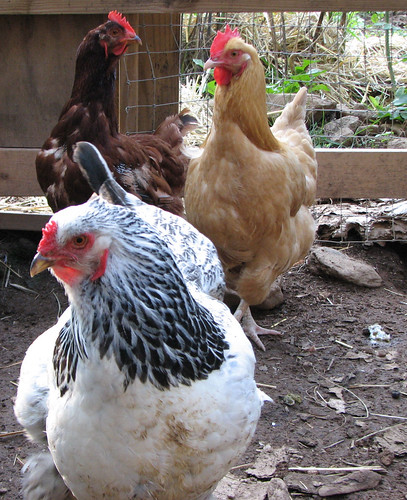
I fell in love with the Light Brahma (the big girl in front) this afternoon. The Buff Orpington and the molting Rhode Island Red are a little shy, but the Brahma is quite friendly and her size may just intimidate any would-be-bullies in my flock. I don't think I have any bullies, unless you count the young guineas (and most of them will be holiday dinners...). The girls should be alright here.
They are three years old just like my oldest hens. They may be slowing down a little in the laying department, but should be o.k. for another year or two. I haven't had to yet cull the hens, but that is something we will have to face in the future. Right now though everyone is laying fine (even these girls, according to Starr) so we won't think about that at this moment.
Friday, October 05, 2007
A little rain
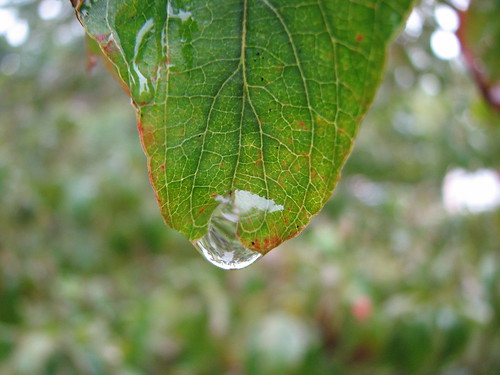
It has rained about a half an inch of rain since yesterday. That's good news for us. We seeded the pasture before the last rain and then there has been nothing for a couple of weeks. Hopefully, this should help.. It's been enough to fill the rain barrels and there is a little more water in the creek. And the ducks are happy, if no one else in the barnyard is. I've posted more photos on my flickr page.
Tuesday, October 02, 2007
Some of the natives
With all these walks in the woods, I'm back to identifying plants. Some are easy...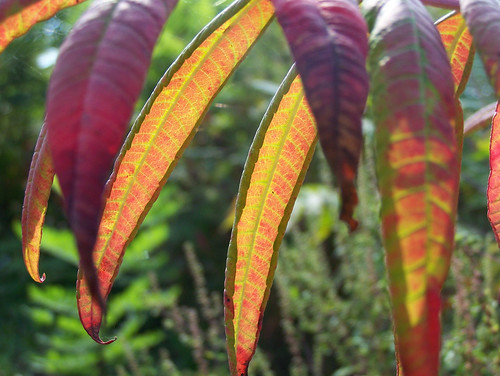
Smooth Sumac
Some are hard. This one in particular is giving me a headache. I'm thinking a Helianthus, but it could be an aster. It's in an open field on top of a mountain at around 3800 feet. The top is an abandoned Christmas tree farm. Perhaps if the flowers were in full bloom it would be easier...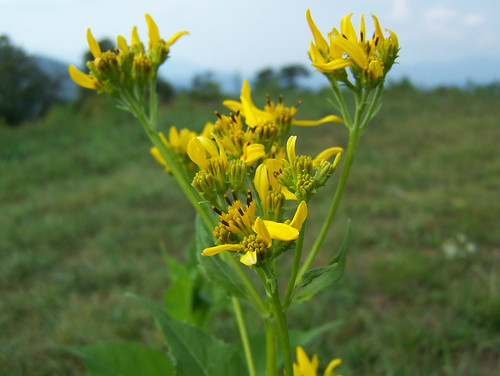
Any guesses?
Sunday, September 30, 2007
Where exactly does the time go?
I haven't been a very good blogger over the last month. I've actually had several incredible entries about local food and dining, but they've all stayed in my head. So while I took part whole heartedly in the Eat Local Challenge, I didn't write very much about it. I can use the general excuse of work. I have been rather busy as my role gets more defined in our new business (which is growing faster than we ever expected). And that has been the exciting part of my day to day existence. Meeting more and more like-minded people and educating the not-so-like-minded has made me feel somewhat better about some of the development that is happening here in Western North Carolina.
I can't, however, blame my interest in work for my total lack of writing this past month. I had grand ideas for the Eat Local Challenge, but I realized I was rather tired of writing about food; having done so all summer. And frankly, when for the second time in two months Gourmet has arrived in my mailbox full of articles about locally and ethically produced food, I think there's not a lot of need for my continued prattle on how good it is to eat with a conscience. Hmm...
So this week involved a lot of this:

Monday, September 24, 2007
Work is hard
I realized over the weekend, when I had no access to a signal, much less my laptop, that I had not posted in over two weeks. I've been so busy with work, that I had little time to form complete thoughts for a blog. There still aren't many complete thoughts, but I'm trying...
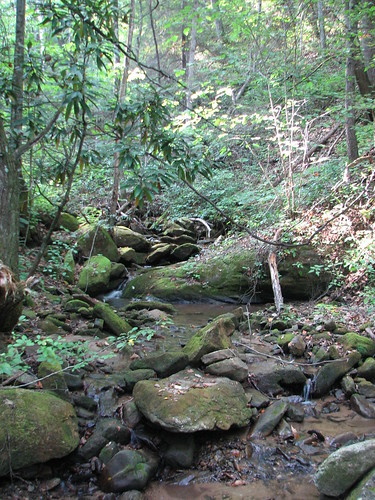
I've been off inspecting trails and consulting. "Consulting", I believe, means "to make up a bunch of stuff for other people to do". Yep, that's it. Anyway, here's the basic view of the world I've been having for the last two weeks.
I can, however, answer a few questions that have come up! Bezzie, as far as drying okra - I believe it does cut down on the slime. I also know that the more you chop up okra, the slimier it gets. Mmmm.
Tasterspoon, I didn't do much research before I bought my dehydrator. Doing lots of research tends to overwhelm and then depress me when I can't afford the 'best' thing... Ha! Like a crazy food saver I dove in and bought the first dehydrator I saw at our local kitchen store. It's the Nesco American Harvest Food Dehydrator and Jerky Maker. I haven't made any jerky yet.
Kitchen Witch - the thought of dried mushrooms was a key factor in buying the dehydrator! Mmmm. (I really mean the 'mmmm' this time.) If you haven't had morels, you haven't lived.
More later, I'm off to finish a couple hand renderings of designs for a client then tackle every imaginable program Adobe has to offer. I mean really, I'm the girl who knows how to make rabbit skin glue and grind my own oil paints... Technology be damned! I guess that is really not the right attitude to have, I'll improve, I promise.
Tuesday, September 11, 2007
The dehydrator
I've had an aversion to the food dehydrator. I'm not sure why. I had a friend growing up. Her mother used to dry and can everything. I think I associated it with the stay at home mom thing (or perhaps the fact that their house seemed to always smell of stewed tomatoes...). My mother was a professional working woman, and the thought of canning probably never entered her head except to remind her of her own hard childhood. All that preserving of food just seemed a little too much work and a little old-fashioned to us, especially the basement room off the rather stylish 70's rec room filled floor to ceiling with shelves of canned peaches, apples, tomatoes, beans, and pickles. Truth be told, that room kind of fascinated me. Our pantry was filled with modern things in bright boxes and wrappers, not ball jars.
So let's skip over all those years of being art student, grad student, starving artist, traveler,development worker, teacher, stay at home mom, administrator, environmentalist, and gentlewoman farmer. I'm raising a lot of my own food and preserving it. My friend's mom doesn't seem so backward, in fact, she seems down right progressive.
This year as I stared at the sprawling, loaded tomato plants, I realized I couldn't possibly can all of them. The cost of buying new jars, not to mention the time involved was intimidating. I really wanted some sun-dried tomatoes, but our mountain climate is not the best for sun-drying. I bought a food dehydrator. I figure I've already made back the cost in the drying of tomatoes alone. And how easy is it to slice up tomatoes in the evening, put them in the dehydrator and have dried tomatoes in the morning? Simple. There were several bags of strawberries in the freezer that needed to be used. So, in a dehydrator frenzy, I threw them in the blender, added a touch of local honey, poured them on to special little sheets and viola!, I had fruit leather for the Monkey. The Monkey eats a lot of fruit roll-ups. At almost a dollar a pop for organic fruit leather bars, I figure the economic benefits could be quite great. Right now there are fresh and local apple slices drying. Next, I'll be drying okra. I'll have plenty of 'gombo sec' for my favorite african recipes, gumbo and soups over the winter. I think I may even try a few peppers, although I generally freeze them. There are bumper crops of all varieties and dried peppers might offer a nice change of pace in cooking.
I think what I like best about drying food is that I can start it and leave it. I'm quite busy right now with work and life in general. I'm seeing more drying in the future.
Monday, September 10, 2007
Saving the harvest
Food preservation has kicked into high gear around Little Creek Farm. I had thought that selling produce at the local tailgate market would cut down on our saved produce, but it doesn't seem to have affected it all that much. We are still up to our armpits in beans and tomatoes.

The dry beans are done - I experimented again this year with a small row of Jacob's Cattle Beans. Last year Charlie picked them all, thinking they were overgrown green beans... They didn't produce as much as I had hoped (but more than last year!). A third of a row - about 10-12 feet, produced just a pound of beans. The artist in me loves these beans and the flavor is good. I might try them again in a larger row, perhaps under something taller, but I can probably use the space for something else. Drying beans is relatively easy. I just leave them on the plant until the pod (in this case the 'green bean') dries and then I pick and shell. As it can be quite damp here, I like to pick them a little early and finish the drying off the plant. Spreading the beans out in the sun on a big sheet layed on the driveway that I can easily pick up at night, or if it rains (like that ever happens...), is the simplest way to dry them. It's a trick I picked up in the Peace Corps. There's less rotting that way. Shelling can be a little time consuming, but it's a nice way to relax on a shady porch on a hot afternoon. Or, if your child is in a Montessori school, you just take in a big bag of beans and those little preschoolers will spend hours picking them out of pods, all the while developing fine motor skills the good ol' fashioned way. We don't consider it child labor, it's character development. Monkey's teachers loved it.
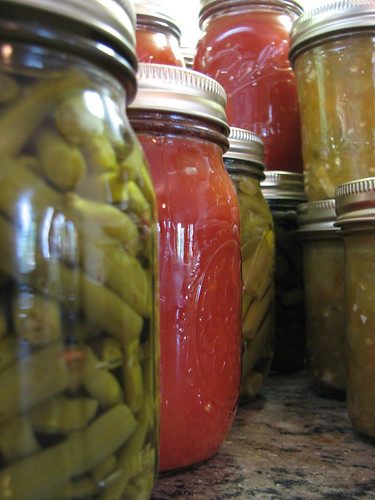
Canning has been an almost nightly occurence for Charlie. He loves to can. There's tomato sauce (I make it, he cans it), green beans, pickles and salsa. Canning is not so difficult (I just get bored easily, and Charlie likes it so much). I would suggest the Ball Blue Book of Preserving. Your local Cooperative Extension is also a good source for information. Tomatoes and pickles are so easy, it's almost a sin not to do it. Green beans and other low acid foods require a pressure canner that may seem intimidating, but truly isn't.
Sunday, September 02, 2007
One Local Summer - Week 10
I can't believe Liz's One Local Summer has come to an end. This summer has been fantastic as we've searched out new sources for locally produced food. To remind you, I've set my limits on the Carolinas - both of them, and any other place we travel to. What has amazed me is that it has taken little effort to find produce, meat and dairy all within a short distance from home. Having one local meal a week has not been a challenge, choosing which meal to post about has. Summer, of course, is a much easier time to search out local produce, but with a little ingenuity and food preserving skills, I think we'll make it through fall, winter and early spring. Having land and a large garden makes it all easier, but I think anyone can garden on a postage stamp-size piece of land, and do it year long. All it takes is a little persistence.
Tonight's meal came all from the Asheville area. Our own community tailgate market ended last weekend, so we headed to the North Asheville Tailgate Market on the campus of UNCA to find a few special items. Produce-wise, there wasn't much that we weren't growing ourselves, but meat and dairy-wise, we hit a jackpot!
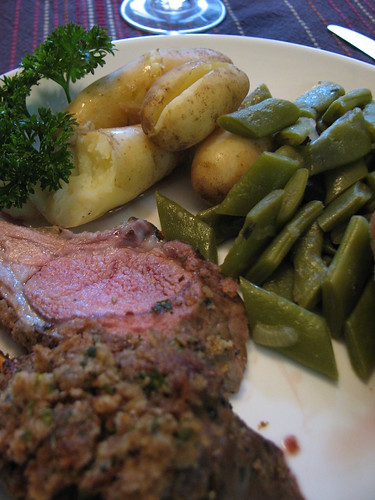
Dinner centered around fresh lamb ribs from Springhouse Meats/Hickory Nut Gap Farm - Mustard and Herb Crusted Rack of Lamb. The mustard was not local, but the herbs were from the garden and the bread crumbs were from a loaf of red wheat bread baked by our neighbor.
To accompany the lamb we had steamed Russian Banana Fingerling potatoes from the garden (a gardening disappointment, but tasty non-the-less) and Roma green beans. We also served kamut rolls made by our neighbor (our plan after the end of our market is to exchange eggs for bread). Nothing except the salt, pepper, olive oil, mustard and the wine came from farther than 17 miles away. Local can be so good!
Now we are faced with the start of the Eat Local Challenge. I've participated each year and this year there are plenty of suggestions to help participants approach the challenge. We generally have local food everyday - almost something at every meal. I'm going to think about the challenge and approach it a little differently -looking for new local sources, writing about restaurants supporting local growers and farmers, and continuing to write about the garden. I'll also share a little bit of what we are doing to preserve our food and how we are continuing to grow as one season winds down and another begins.
I guess it's a little bit like my post yesterday. Just because one season is ending, you don't have to stop the momentum gained over the summer. This time of year harvest is in full swing. I guess this is the month to party!
Saturday, September 01, 2007
Gardening Friday on Saturday
I spent most of my week tied to the computer cataloguing plants and their characteristics for a new database. Interesting, but draining. I felt I would never get out of the maples (acer, to be more exact). The Japanese Maples took damn near forever. Who knew such variety could be had? Well, I knew, I just never had to sit down and type out the details of so many before. Thanks to the lovely and diverse acers, it took me two days to get out of the letter 'a'. I'm now on the letter 'd'. Life is that exciting...
So as I was writing about so many ornamental plants and their care, I'd glance out my window and notice how neglected my own gardens were. August is a draining month. It ranks second behind February in my vote for worst month ever. The heat tends to leave everything in the garden a little worse for wear. And as crops begin to ripen, it's easy to spend all your time out in the sun picking tomatoes, greenbeans, and way too many squash and cucumbers. With all the processing and saving of produce, there's little time to take care of the plants. My garden turns into a wild thing. The ornamental gardens tend to suffer the same fate and everything looks like it needs a makeover (much like me, who had to cancel my hair appointment TWICE this summer and am anxiously waiting Wednesday when I finally get to have my hair cut...).
Needless to say, I've spent all free time yesterday and today in the gardens weeding, pruning and tidying. Charlie joined in this morning and we tore through one perennial bed and half the vegetable garden. The Fuji apple tree was staked. Roses were pruned. Daylilies were divided. One peony was moved and another marked for moving tomorrow. Tomatoes were picked and diseased leaves removed. The compost bins were filled with cuttings and weed pullings. The last of the potatoes were dug and rows were weeded and prepped for planting. Planting?, you ask. Why, yes! Just because summer is almost at an end doesn't mean the gardening season has to be. There are plenty of cool weather crops to plant and a few warm season crops that can go a second round before frost.
We've begun fall planting. We started about two weeks ago. Already, there are new crops of kale, lettuce, beets and radishes popping up in the garden. I'm even experimenting with a row of leeks. Here, in the somewhat south, there is still time for another row of greenbeans. If they don't produce much, they will make an excellent cover crop until the first hard freeze. Tomorrow we will be planting peas, kohlrabi, more lettuce, and whatever else looks good in the leftover seed stash. Several rows will be getting a green manure cover crop of oats. I'm trying them this year for the first time. They won't survive the first hard freeze, but should make a nice layer of plant material to hold the soil over the winter.
If you've never tried fall gardening, I highly recommend it. The season can be extended even longer with row covers and some things, especially cole crops taste sweeter after a nip of cold weather. We'll be setting a few things in a cold frame made from leftover pieces of the old greenhouse (I'm thinking the new one won't be up until late fall/early winter).
And tomorrow after all that planting we will be sitting down to our last One Local Summer meal.
We found the centerpiece today at the tailgate market and it's so fresh and so delicious looking that I almost made it tonight. I stopped myself when I realized there was about 30 pounds of tomatoes in the kitchen sink that needed turning into tomato sauce and another ten or so that need to be dried. So the meal will just have to wait until tomorrow. Now go use your Labor Day Weekend for gardening good and plant a cool weather crop or two.
Thursday, August 30, 2007
Beware of what you say to a four year old...
...because when she's five it will come back to bite you in the, eh hum, rear.
About three weeks ago Monkey and I walked through PetsMart to buy frisbees for Gigi (they're a dollar and she loves her frisbees...), we made our normal detour (yes, we buy frisbees and balls on a rope quite frequently...) to the kittens and cats up for adoption. Monkey understands that we will not be adopting a kitten, but we still like to window shop (the same goes for the hamsters, gerbils, parakeets and lizards). The pet adoption area is adjacent to the tropical fish area.
As we passed the rows of fish tanks, Monkey said to me, "Momma, remember when we bought Rainbow Prince (A lovely, little, deep blue Betta, who swims in a small tank on her desk)?" "Uh, uh, " I replied cautiously because something in the tone of her voice suggested she had just let one shoe drop. "Momma (the repetive use of 'Momma' normally means something is going to be requested...), you said if I took care of Rainbow Prince for a year, I could have an aquarium." I waited. "Momma, it's been one year." Bam! The the other shoe dropped. It had indeed been almost one year to the day since we brought Rainbow Prince home and placed him in one of the most lavish set ups for a Betta ever devised - filtration, live plants, color coordinated gravel...
"Momma, you said," she added to emphasis the fact that she had held up her end of the bargain and now it was my time to pay up. And pay up, I did. We now have a 40 gallon aquarium in the house, with fish and all. I won't go into the cost of setting up an aquarium. I did promise, and I have this thing about sticking to my end of the bargain. And I'm sticking to my end of the bargain with a vengeance. Because, when you buy fish from PetsMart, they of course are going to have something - like a fungus, that shows up right after the warranty ends and you have to go out and buy lots of things to treat them with and then a few die and you'll have to replace them (or not) when the tank is all clean of any illness. My pocket book is aching. I hope Monkey's elephantine memory is working at Christmas when she only receives new socks and underwear.
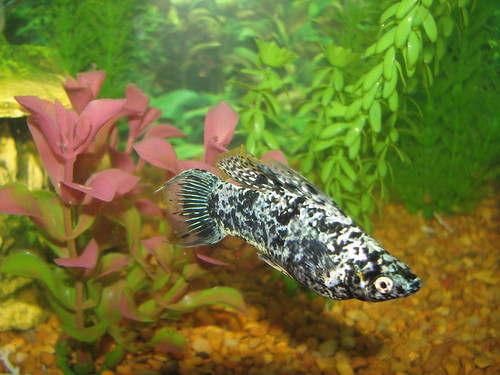
And each fish has a name, although the neon tetras are just Rainbow Stripe #1 - #5. Here's Speckle Bucket (the kid has a flare for names, what can I say) the self-proclaimed king of the tank. He and his wife, Lola George, are expecting. One of the Wag Tail Platys has already given birth and one of her offspring is hiding in the foliage and growing daily. Please take my advice and beware of what you say to a four year old.
Sunday, August 26, 2007
One Local Summer - Week 9
Week nine of One Local Summer has been extremely hectic, what with the start of school, work deadlines and a two-day dog training clinic in the opressive heat of South Carolina. We did manage to squeeze in at least two meals that were almost local. In both instances it was the grains that threw us. Unfortunately, I was too busy eating to take pictures. This pleased Monkey, who thinks that taking photographs of one's food is terribly rude. eh hmm.
Monday night we had a shitake mushroom and wild rice soup. The mushrooms came from a fellow tailgate vendor who lives in Black Mountain - 10 miles. The beef broth came from our freezer. I do believe that the beef which originally contributed to said broth was local from our Virginia source. The wild rice was not local, but it was good... The soup was incredible. As an accompaniment we had kamut rolls made by our neighbor - source of production 1 mile (the grain came from Montana...).
The second meal was spaghetti and marinara sauce. We seem to be eating a lot of tomato-based sauces right now, but we might as well eat while the tomato picking is good! The spaghetti was not local (but was organic). The sauce was made completely from our garden - tomatoes, onions, garlic, basil and oregano.
Now that the food posting is done, I'm going to turn off the computer for a while. The sky is dark, the wind is picking up and I hear thunder. We supposibly are awaiting a huge storm, which around here means loss of power. At least I think that's what normally happens. It's been so long since we've had a thunderstorm or precipitation in any form, that I've forgotten what actually happens.
Friday, August 24, 2007
Gardening Friday

A garden should be a microcosm of the larger environment. A healthy environment has a variety of inhabitants. Some, like potato beetles, flea beatles, hornworms, and crows want to eat what you want to eat. Others want to eat the beetles, hornworms and at least chase the crows. The predators in my garden make my job as gardener much easier. The key to attracting and keeping the predators is creating an attractive environment for them.
There are several ways to make your garden enticing to the "good" residents. In the simplest terms, provide them shelter (and food) and they will come. (Isn't that why the "bad" bugs come as well?) I plant plenty of annual flowers and herbs - marigolds, zinnias, sunflowers, basil, parsley, and borage scattered throughout the garden. These attract bees and other polinators. They provide shelter to spiders, lady bugs, praying mantids and a host of predators. There are also several spots dedicated to perennial herbs. I leave a grass border around the garden within the fence to offer protection as well. Clematis and annual vines are allowed to climb on sections of the fence where they won't block sun. Outside the fence and near the garden are wood piles, rock piles and more flowers, many native that again provide protection for my little helpers.
It's comforting while picking potato beetle larvae off of the leaves to see a predatory wasp hunting for the nasty little critters as well. I don't feel so alone in my little battle to bring in a harvest. The lovely garden spider has taken up residence in the leaves of a tomato plant. Tiny spiders and some larger, more intimidating Wolf Spiders crawl about in the mulch. There is a toad living under a broken flower pot surrounded by cucumber vines. In the morning while I'm picking tomatoes, the garden is filled with the chattering of goldfinches hanging from giant sunflower seed heads (I plant them just for those birds...). I even think the crows have taken care of most of the hornworms while they help themselves to my tomatoes (good, or bad, you decide). Bill, the Cat likes to hide under the black-eyed peas and leap out at the crows.
So look for the "good" in the creatures that enter your garden. While the garden spider that shows up in August may be a surprise when you reach for a tomato, know that she's helping you keep pest free. And she won't bite, I promise (this is coming from an avowed arachniphobe). Toads love slugs and I love toads! Even the chickens and guineas help by eating bugs outside the fence and feasting on those I pick from plants. Why not do a little nature hunt in your garden and see who's set up home in the environment you've created? You might be surprised.
Thursday, August 23, 2007
Stopping the energy hogs
Our switch to clothesline over electric dryer has saved us a bundle this summer in electrical bills. Changing many of our bulbs to florescent has helped as well (although I'm tentative about the whole mercury thing and there is the color of the light thing that bugs the artist in me...) Here's something for those in this area - I found on a shelf at Greenlife on Merrimon free bulbs! You have to look a little. I think they were in the cosmetic/supplement section maybe near the fish oil, if memory serves. Imagine. There are so many ways to cut back a little, save some cash and reduce energy consumption. e4 has given some really helpful hints on cutting our computers' energy gobbling habits. Soon, I will be brave and tackle that "octopus" behind my desk, I promise.
Wednesday, August 22, 2007
Chickens as nature intended
Nature has a plan and I've decided that this is the way to raise chickens. It's much easier than picking them up at the post office, checking on them hourly, cleaning up after them and fearing the brooder lamp will go out sometime during a cold snap on an early spring night. There are drawbacks - predators, disease, uncertaintity, but the chickens seem especially happy being, well, chickens. And Broody #1 and Broody #2 are showing some good mothering genes. Today as I was trying to pick up the surprise chicks I was attacked by Broody #1 (that's a drawback, for sure). She's left a rather hefty mark on my hand for trying to make contact with her babies. I have no idea if she is the biological mother of any of the four chicks, but they belong to her.
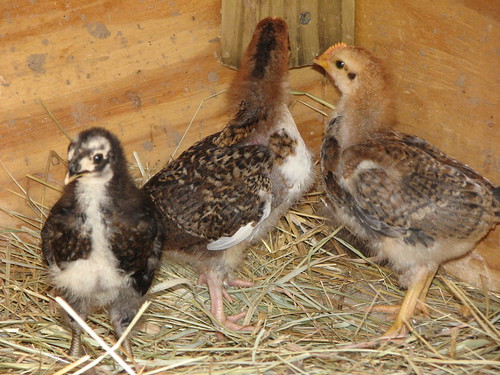
Here are three of the four chicks. The other was being naughty and hanging out in the other pen. Another few days and they won't be able to fit through the 2 inch wire. The shy one in the middle is my favorite. I think it is another Speckled Sussex. My money is on the yellow-legged one on the right being a boy. The one on the left is a funny looking kid. There are partridge patterns, laced patterns and speckling. Number Two (who I inherited from Jaime) is most likely the father of these three. Although Lefty could be a Speckled Sussex hen and Rufus, the Golden Laced Wyandotte. The AWOL Chick is black, like its mother.
There are only 3 more days until hatch. Broody #2 has been at it through all this heat. We are keeping fingers crossed for more chicks and maybe another Speckled Sussex or two. I know there is one Ameracuana egg (I've only one hen left), so maybe a green egg layer will hatch.
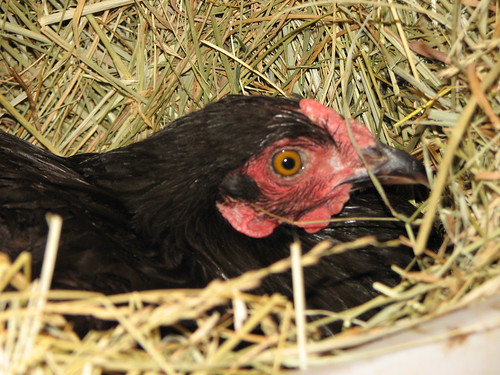
While I do like this method, I am still planning on a big order this coming spring. I skipped it this year. With an eye on the egg market, I'm thinking more Ameracaunas, a few more Black Australorps and some Barnevelders for variety in egg color. The Australorps just lay like crazy and both of the broody hens are offspring of my two Australorp hens and Rufus. Come to think of it, maybe I'll add a few more Wyandottes to the flock. Stop me now, please.
Tuesday, August 21, 2007
Another reason to eat local vegetables
At the Monkey's annual checkup I got into an interesting discussion with her pediatrician. She asked me what I knew of hepatitis A. I said I thought I had been vaccinated for it (like a gazillion other things) while in the Peace Corps and that it was generally transmitted through feces and (ew!) therefore through food and water. Close personal contact, food and water... There are a few high risk groups, people traveling to certain areas of the globe included. hmm. So where was this conversation going?
Well it seems that it is now recommended children receive immunization for hepatitis A and the State of North Carolina pays for it. The pediatrician explained that with the increase in consumption of fruits and vegetables from Central and South America there has been an increase in incidents of hepatitis A. She's not an alarmist type. And she suggested that Monkey get vaccinated (even though we rarely eat imported fruits and vegetables at our home). Perhaps eating local is even better for our health than we thought.
Friday, August 17, 2007
Gardening Friday

Fridays are generally my day to stay home and garden, then write about it. Lately though, I've had very little time to write. I've been spending most of my time in the garden trying to stay ahead of the weeds, disease, and pests (not to mention the overabundance the garden produces even in a drought). This afternoon with the heat climbing into the 90's and the humidity hovering around the same, I decided to pour myself an iced tea, kick back, and write about what I've been doing.
We always experiment in the garden, and this year has been no exception. A couple new (to us, that is) tomato varieties are wowing us. One, Stupice (which is new to us, but a favorite of many), has proven that big is not always better. It's sweet, zesty, red - everything "tomatoey" in a 2 ounce nugget of goodness. Principe Borghese is another favorite. It's small fruits are great in sauce and candied, as in a previous post. It's meant for sun-drying, but the humidity is way too high and we don't have a dehydrator. I'm not so happy with Black Prince, a favorite from last year. The fruits are much different than the plant we grew before and instead of being incredibly blight resisitant, this year's plants succumbed well before the start of August. I think it may be the down-side of heirlooms - plants with the same name can vary by location and supplier. In this case, we ordered from a different supplier this year. Next year, I'll look for the old variety and give it one more try on a limited scale. I'm going to try to save seeds from Kentucky Beefsteak and Spear's Tennessee Green and see how they do in comparison to ordered seeds.
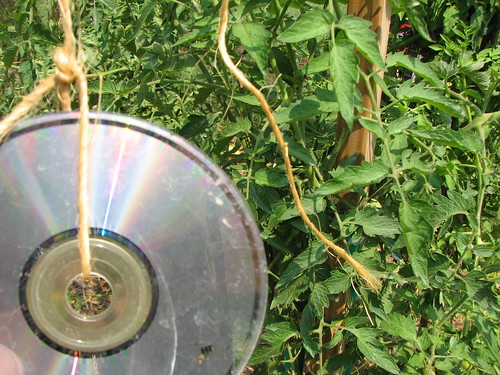
Crows have been a problem this year. I think it has to do with the drought as much as anything else. Last Friday I hung old cds throughout the garden, especially around the tomatoes and from the scarecrow's arms. They flash in the sunlight. The ones on the scarecrow bang into his trashcan lid body, especially on windy days like today. It seems to be working. And best of all, I'm giving old, ruined cds new life. Reduce, Reuse, Recycle.
I've also been fighting powdery mildew with milk. Yes, milk. Mix 1/2 cup milk to 2 cups water and spray the leaves of cucumbers, squash, or whatever else seems to be succumbing (powdery mildew thrives in dry weather, oddly enough). So far, it's working. I had always been a little doubtful of this particular home remedy. Apparently for a brief time after application the milk, in combination with sunlight, turns into a natural fungicide. I've been applying it about every three days, always when it's sunny. Just remember to wash out the spray container when you're done - please don't forget and leave it in the sun. Trust me, doing it just once will keep you from doing it again!
Next I plan to attack the slugs, testing a variety of home remedies. This year has been worse than any other year. I think because the heavily mulched garden is the only place they find hospitable at the moment. Not for long slugs! You're going down...
Thursday, August 16, 2007
One Local Summer - Week 8
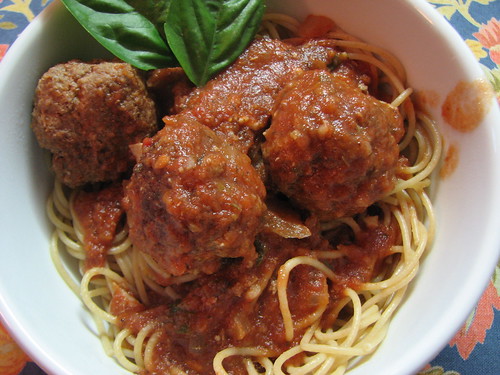 We came home today from a day of work down on the Tuckasegee River. I realized with a slight sense of panic that we had not yet had and "official" local meal and with the way the weekend is planned, I needed to make it tonight. So, I quickly scoured the freezer, pantry, fridge and countertop and came up with this:
Monkey's Favorite Spaghetti and Meatballs
The meatballs are ground beef from Hickory Nut Gap Farm/Springhouse Meats, Fairview, NC - 17 miles; bread crumbs from City Bakery whole wheat bread, Asheville, NC - 8 miles; duck egg - 0 miles (that's right - duck egg, they're laying!); and herbs - 0 miles.
The sauce is made with tomatoes, garlic, onion, zucchini (ground up fine, so the Monkey will never know), and herbs from the garden - 0 miles.
The pasta is not local, but I think the topping more than makes up for the fact.
Now I'm off to turn more tomatoes into sauce. I need the counter space.
Monday, August 13, 2007
Tomatoes a-go-go
The tomatoes are coming in here at Little Creek Farm. I have been battling our local murder of crows (I love that collective name, by the way) for the rights to the fruits of my labor. This particular family had been marauding all over the cove. They hit one neighbor's garden everytime he planted corn or beans. Another has been losing tomatoes left and right. They finally hit our garden about 10 days ago. They wait until the tomato is perfect to strike. Then they take a bite or two and move on to the next red nugget. Bastards. Anyway, I've set up a little system to see if I can annoy them enough to keep them at bay (Lord knows the scarecrow's not doing his job...). It, along with a few other experimental things will be going into this week's garden post. Let's just say that I'm experimenting so you don't have to!
In spite of the crows, I'm hauling in quite a few tomatoes. I'm making the sauce up in batches and sticking it in the freezer until I have enough for one big canning operation. I love my new food mill. Tomato paste has never been easier. I can't wait until apple season, as slim as it will be here, to make apple sauce. We've also been getting loads of Principe Borghese tomatoes. I now see while everyone raves about them. I want to make sun-dried tomatoes, but the humidity is just too high here (and after buying the food mill, it will be a while before I can purchase a food dehydrater). So, I thought they just might be perfect for one of our favorite things to do tomatoes - here's the recipe taken from The Italian Country Table, by Lynne Rossetto Kasper (I highly recommend the book, if just for this recipe and her very simple, lovely pizza dough!). I enjoy the stories of the farmers and artisans who raise and create the ingredients as much as the recipes.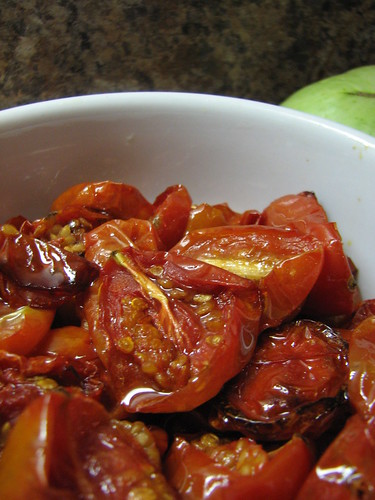
OVEN-CANDIED SUMMER TOMATOES
Preheat the oven to 400 F.
Take around 2 to 2 1/2 pounds of medium-sized tomatoes. In this case, I used the smaller Principe Borgheses. Core and cut them in half. Larger tomatoes can be cut into smaller sizes. In a half-sheet pan, or shallow metal baking pan (must be metal), arrange the slices cut side up about 1/2 inch apart. Coat with extra-virgin olive oil and sprinkle with salt.
Bake 30 minutes, then lower the temperature to 350 F. Bake another 30 minutes and lower the temperature to 300 F. Bake another 30 minutes (you see where this is going) or a little longer until the edges of the tomatoes start to darken. If they haven't yet colored you can lower the temperature to 250 F and bake for another 10-15 minutes. Remove the tomatoes from the oven and cool 20 minutes. Transfer them to a shallow glass or china dish and pour their oil over them. Let them mellow, uncovered, at room temperature for 4-6 hours.
You can layer them in a covered container with the oil and store in the refrigerator up to 6 days, or freeze (as we do). They are a great taste of summer in the middle of winter.
Cooking them this way intensifies the natural sugars and mimic what Sicilian farm women did with the tomatoes by placing them in the cooling bread ovens after the loaves came out. Just think you can heat up the oven to make a nice crusty loaf or two and make these tomatoes to go along! Enjoy.
Sunday, August 12, 2007
One Local Summer - Week 7
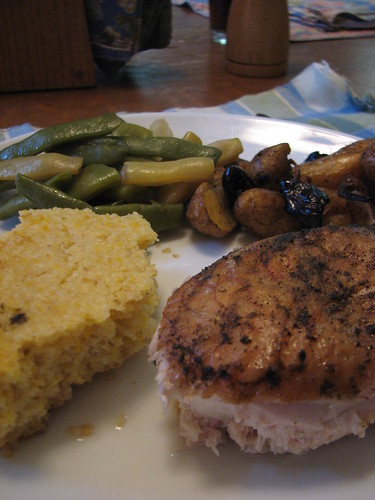
Mmm - Sunday night dinner.
In the middle of all the chaos that is our household; we slowed down, sat down, and had ourselves a slow, pleasant dinner. We managed to clear tomatoes out of the way and cook ourselves another fantastic meal.
Roast Chicken, cooked on the grill - from Foothill Family Farms, Old Fort, NC - 20 miles. It was butchered Friday, and we picked it up at the tailgate market on Saturday.
Roasted Russian Banana Fingerling Potatoes, dug minutes before - the Garden - 0 miles.
Roma II and Golden Wax beans - the Garden - 0 miles.
And cornbread made with corn meal from about 25 miles away; milk from Harmony Dairy, Westminster, SC - 100 miles; eggs from our hens, and flour from NC as well.
After my walk with Gigi, we are now sitting in front of the television watching Iron Chef America where the "secret ingredient" is FARMER'S MARKET. Go figure.
Oh, and for all of you hanging on for the Garden entry (I know you're dying out there without it), I'll have it up tomorrow. I promise.
Sunday, August 05, 2007
Surprise!
Just when we thought things were getting back to normal around here, one of the black hens shows up with four little chicks. Mother and brood are quite happy in one of the little coops - scratching and pecking, scratching and pecking with a whole lot of clucking going on.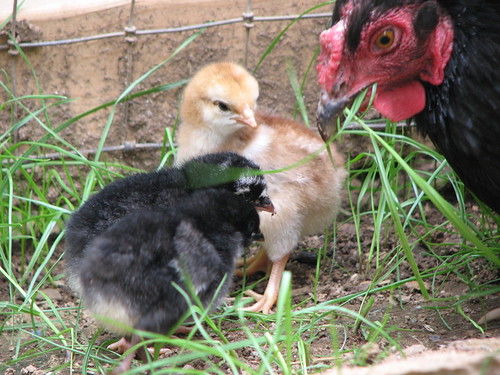
One Local Summer - Week 6
After almost 2 weeks of eating take-out and chain restaurant and midwestern comfort food, it was nice to get home to fresh home-cooked meals. We nourished ourselves daily with food from the garden. Our lunches (and at least one dinner) consisted of baked potatoes and green beans, with a few tomatoes thrown in. It was hard to choose a meal this week to label our OLS meal. Last night's meal won out.
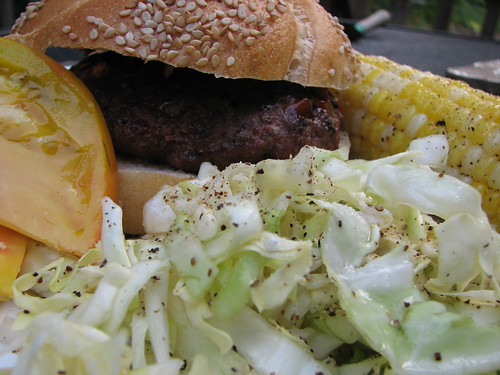 We grilled hamburgers made with beef from Hickory Nut Gap Farm/Spring House Meats, Fairview, NC - 17 miles. The buns are from Annie's Naturally Bakery, Sylva, NC - 48 miles.
We served it with corn from Old Fort, NC - 20 miles; slaw made with cabbage and onions from the garden - 0 miles; and tomatoes from the garden - 0 miles.
Oh, and dessert - french vanilla ice cream made with whole raw milk from Harmony Dairy, Westminster, SC - 100 miles and eggs from our hens - 0 miles.
Seasonings and condiments, except for the Duke's Mayonnaise, where all non-local.
Friday, August 03, 2007
Gardening 101
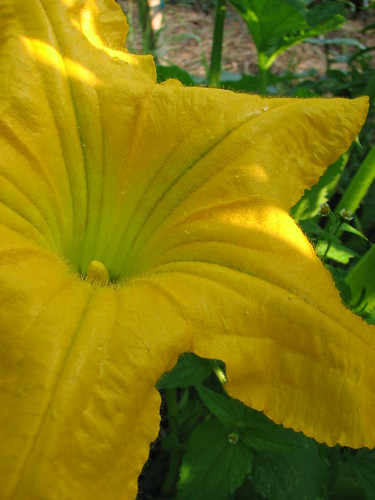 Any gardener that has left her garden alone for a period of time returns to face work. Weeds don't refuse to germinate just because of a vacation (or in my case, a funeral). Pests don't seem to be sympathetic to grief. However, working in the garden until my back aches and sticks in a bent position, my hands cramp in unnatural claws and my shoulders are sunburned does help assauge some of the aching in my heart. A gardener knows the healing properties of the earth.
Good things happened in the garden during my unplanned two week absence. The beans flourished; even surviving an attack of rampaging goats (the grape was not so lucky, but will recover). I picked close to five pounds of Roma II, Maxibel Haricot Verts, and Golden Wax beans yesterday. There were enough Roma and Principe Borghese tomatoes to make a delicious pasta sauce last night. I dug out weeds and prepared beds for a second round of planting. I slept throughout the night for the first time in a long while.
But like I said, pests don't care that I'm grieving. They thrive in my absence. I saw signs of insect damage throughout the garden yesterday and picked many a slug and a tomato hornworm or two to toss to the chickens as I weeded yesterday.
This morning I tackled this week's gardening topic - Squash Vine Borers (or as they are known around here - gross little bastards...). They end up in even the best gardens and I'm sure they have their purpose, but I want my squash. They had to go. Armed only with a sharp paring knife and garden trowel, I was able to remove them and save my plants.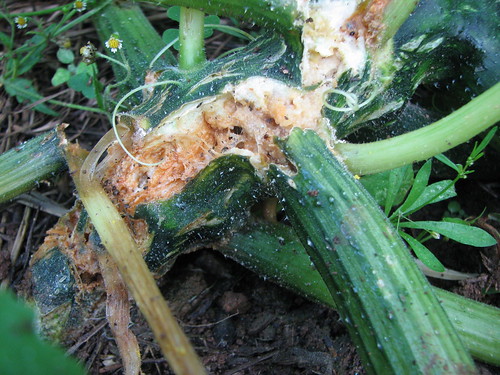
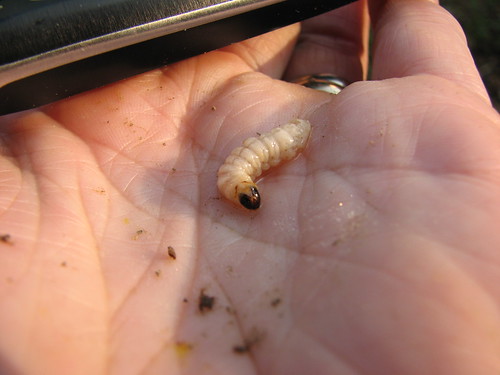
The Squash Vine Borer (Melittia curcurbitae, for those of you who like to know these things) is a moth larva that feeds on the stems of members of the squash family (squash, pumpkins, gourds, cucumbers) for up to 6 weeks. It then pupates in the soil. This is what the damage looks like. You can avoid it by keeping young plants covered with row covers or treating the base with a nice organic insect repellent - both I skipped...). If your plant gets to this state, you can do a little operation to remove the larva and hopefully keep the plant.
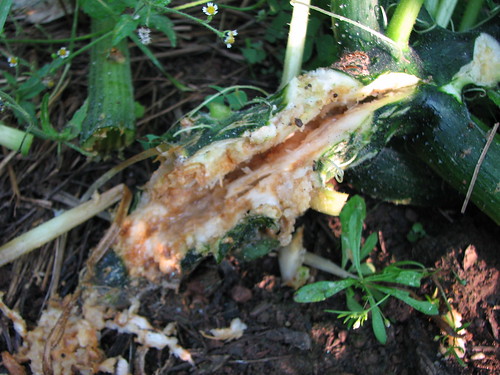
Make a slit in the stem of the plant. Generally I find the larva above the damaged portion - so cut higher up than the mushy part. In this particular zucchini I found four borers. Remove the larva and gently scrape away any mushy parts. Cut off damaged leaves and stems.
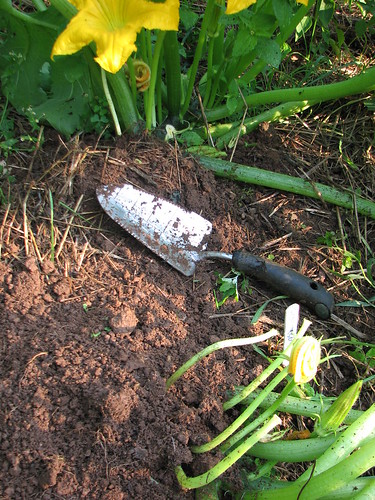
Finally, mound dirt up around the squash vine. It should root in the soil and continue to lead a happy life. I like to spread a little diatomaceous earth around the base to discourage insect pests and slugs. Members of the curcurbit family are kind of resilient, so hopefully they will continue to produce way too much zucchini for a long time.
Wednesday, August 01, 2007

Sunday, July 22, 2007
Must take a hiatus
I need to take a short hiatus to deal with some family issues. Don't worry, I hope to be back by the end of the week. I've got a great topic for Gardening 101. I'm not so sure I'll have an OLS meal this week, but never say never.
Tuesday, July 17, 2007
One Local Summer - Week Four
My time at home this week is very short. I had to hop down to Georgia for a board meeting on Sunday. Tomorrow I leave for Missouri to visit my mother, who is ill. I spent yesterday running around and doing everything that needed to be done in the week in one day.
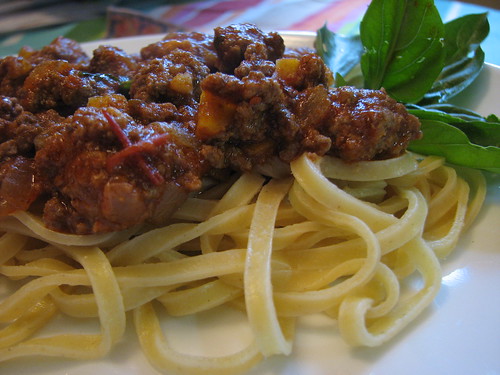
I fretted over what I could make in a short time and what I could find local at the grocery store. We generally do our local meal on the weekend - when there's time to prepare and savor it all. We are all scattered this week. Charlie had a meeting last night. Monkey wasn't finished with camp until 5:00. I was settling on hamburgers when out of the corner of my eye I saw, on the the refrigerated shelf next to the smoked trout (local), pasta! I've been wanting to make pasta, but let's face it, it takes time to prepare. I found it fresh and made in Charlotte. While I can't verify that the ingredients are all from the Carolinas, I can say that it's made here. So here was our meal. And it was fast to prepare - about 45 minutes from the first chop of garlic to the plate. Active time was closer to 15 minutes. Monkey and I dined like queens.
Linguine Bolognese
Linguine - from Pasta & Provisions, Charlotte, NC - 131 miles
Ground Beef - Spring House Meats, Fairview, NC - 17 miles
Tomatoes - the garden - o miles
Garlic - the garden - 0 miles
Carrots - the garden - 0 miles
Basil, Bay, Oregano - the garden - 0 miles
not local - salt, pepper, milk
Let's not forget dessert!
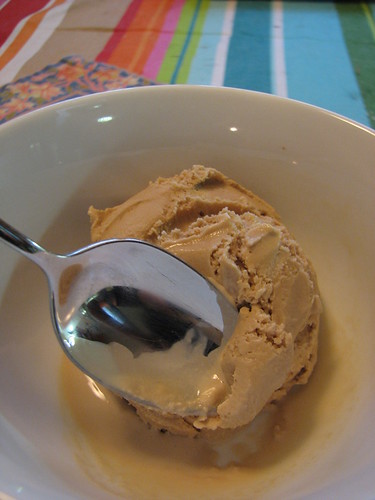
We don't generally do dessert around here, but it was Monkey's first day of Art Camp and I'm going to be gone for awhile, so we stopped at our favorite local ice cream shop, Ultimate Ice Cream (5 miles from our front door), and picked up a pint of Lemon-Lime Sorbet and Black Mocha Stout Ice Cream. I'm glad that we've instilled in the Monkey an appreciation for small local businesses, where things are crafted with care and are better for it. She even requests the sorbet over Oreo or Bubble Gum. The Black Mocha Stout Ice Cream is made with Black Mocha Stout (duh...) from Highland Brewery. I have to say, that it is one of the best mocha ice creams I have ever tasted.
Dinner was fresh and local and fast.
Friday, July 13, 2007
Weekly Gardening 101
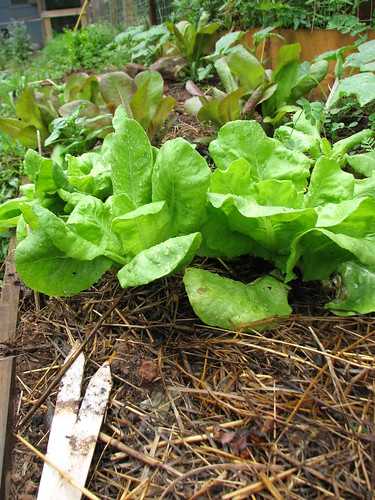
There are many ways to prepare a bed for planting vegetables. Some, like double digging, are incredibly labor intensive. I've spent many a spring soaking a sore lower back and repairing my winter-tender hands after a day in the garden. I've discovered that preparing a garden doesn't have to cause back problems or aggravate my arthritic hands.
Usually preparing a new garden involves three things - removing whatever is already growing there (usually grass or weeds), loosening the soil underneath, and improving the soil. In the past, I've used a shovel, hoe, pick, a rototiller, and my own bare hands to accomplish the first two steps. In the past year I've been using a much easier method. Starting now (or preferably, later in the cooler weather of autumn), you can prepare a bed for planting next spring with minimal physical exertion.
Once you've determined where you want your garden (I'll leave the size and shape up to you, just think that wide beds with narrow aisles allow more planting and less weeding), you can start to get it ready for spring planting. What you will do is leave most of the green stuff growing there to help add organic material (food for your veggies) to the soil. Nature's little helpers - worms and other organisms in the soil, will help loosen the soil. Mulch that you add will also help improve the soil. You'll be able to plant in the spring with minimal effort. I promise. Starting in the fall means that your soil will be improved over the winter with the help of worms and other critters in the soil. Worms are your friends. They will help break down organic material, and aerate and loosen the soil with their little tunnels all through the cooler months.
Here are the steps:
- Cut down any tall vegetation and woody weeds in your new garden location. Remove any woody material or things that have gone to seed. Lay a base layer of cardboard or newspapers at full thickness over the area. Make sure to overlap the edges. This is biodegradable and keeps the light from reaching the stuff underneath.
- Next add a layer up to 4 inches deep of soil improvers - compost, grass clippings, leaf mold or fallen leaves, composted manure, mushroom compost, or animal bedding (old straw or hay). A mixture of these materials is good. You can buy many of these at a garden center, if you don't have them laying around, but leaves and grass clippings are free (so is animal bedding and manure, if you a lucky enough to have animals! No dog or cat poo though, these can contain icky things that can infect us as well).
- Then add a top layer of straw or hay. This will retain moisture and look good. Wood mulch looks good, but a caveat - wood actually takes nitrogen out of the soil as it breaks down. Shredded bark mulch is a better choice, but expensive. I'd stick to straw.
- Water this all to settle the layers and keep it all from blowing away.
In the first year, it's best to grow transplants. Small seeds and root crops are suitable for the first year. If time has done the work for you, the light blocking layer will start to break down and the organic materials layer will start to mix with the soil. If you have a problem with bigger perennial weeds, just dig down through the layers of mulch and dig out. You can always add a second layer to help block these out.
I've found that a crop of potatoes is excellent at helping to break up the soil. These can easily grown using thick layers of straw as mulch. But a warning! Once you have homegrown potatoes, like their cousin tomatoes, store-bought will never do. I promise.
This method can also be used with existing beds to cut down the weeds and improve the soil. I did it over the winter with several rows in our garden (I need to see things to believe them, you know) and the difference is amazing. I'm finally winning the battle with mustard garlic and creeping buttercup. This fall all rows get this method.
That's it for this week. Send any questions, and I'll try to answer them. It may help me come up with a topic for next week!
Tuesday, July 10, 2007
I want to be in pictures
I'm a Simpsons character. My life is now complete. And I've just taken part in a shameless advertising ploy for a movie. Oh well.
Sunday, July 08, 2007
One Local Summer - Week Three
 We went southern this week with the local menu. There we no leftovers tonight. The Monkey had two helpings of everything. Some days nothing satisfies like fried catfish. I grew up on the banks of the Missouri River. With the uncharacteristic heat and humidity we've had, I almost feel like I'm back home. The recipe for the catfish was in this month's Gourmet, which is full of local food articles. It was quick and easy without the mess of frying. Don't think that oven-fried means low-fat; there's 4 tablespoons of oil for 4 catfish filets. I toyed with the idea of making some hushpuppies, but thought it safer for the arteries to pass this time.
Oven-Fried Catfish - NC farm-raised, from exactly where I'm not sure. It's soaked in eggs from the garden and dredged in cornmeal from Blue Hill Farm - around 25 miles away.
Green Beans, Yellow Wax Beans from our neighbors' - 2 miles, and Potatoes from the garden - 0 miles, seasoned with Bacon from Spring House Meats/Hickory Nut Gap Farm - 10 miles.
Sweet Corn from a farm in Old Fort, NC - 20 miles
We washed it down with iced tea. Mmmm...
Saturday, July 07, 2007
Market Day 7.7.07
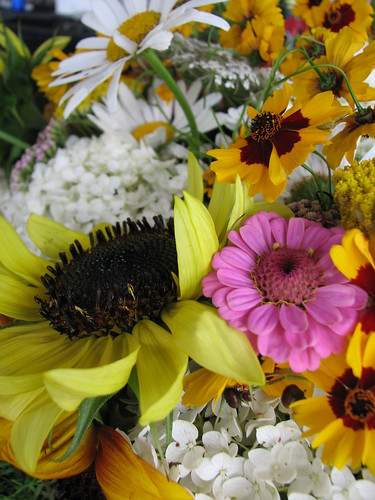 It was another great market day. We had plenty of fresh flowers, carrots, potatoes and beets to sell. We picked up a fat chicken for later in the week, as well as green and yellow wax beans.
Hydrate locally
This past Tuesday I listened to a discussion on Public Radio regarding this article and it really got me thinking. I thought I'd share. Where does your water come from?
Friday, July 06, 2007
Weekly Gardening 101
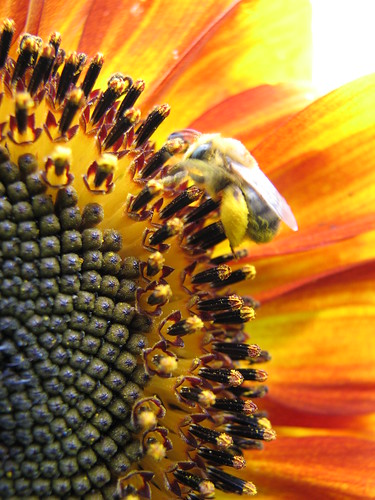 Every gardener needs a helper
Better People Through Better Food. Liz mentioned in a comment for an earlier post the need to encourage more people to get out and plant a garden. I've been mulling over the comment and have decided to address that issue every Friday. I love gardening almost more than eating the things I grow. I may be a little odd that way. If you are new to gardening, or have been gardening a long time, but are stuck in a rut; perhaps this will help. I've found a lot of inspiring stories and information on various blogs and I'd love it if others would share their thoughts. So let's start with some of the basics.
YOU, THE GARDENER
Many people are totally in awe of the ability to grow anything. It's my belief that anyone can garden. It's a matter of knowing needs and limitations - both the plant's and the gardener's. We'll start with the gardener. What are your needs? What are your capabilities? What are your limitations? How much time do you want to spend in the garden? How much time can you realistically and honestly spend in the garden? The last two questions often have very different answers. Discovering a little bit about what kind of gardener you are will help determine what kind of garden you will need.
BUT WHERE? A FEW IDEAS...
Many a gardener, myself included, has been overwhelmed by too big a task. Decide what you are truly capable of doing and plan accordingly. It is much easier to start small and grow than to be overextended and feel defeat with too large a garden. A large garden takes a lot of time to prepare and plant. A small garden can take an afternoon to prepare and a few minutes a day to maintain. If you have no garden, but would like to start one, look for the future location now at the peak of the growing season. Pay attention to where the sun is during the day. Vegetables are generally not shade plants and need full sun for at least 6 hours a day. We'll talk more about preparing a bed later. For now, if you have no garden space you can still, even this late in the summer growing season plant things to enjoy. Check your local garden center for plants or buy a pack of fast growing seeds. Soon, in many regions, you can plant for cool weather fall crops (they are often the same crops that are ready early in the spring).
Vegetables can be stuck almost anywhere you can find a space. When we were the uber-urbanites, living in the city (our total lot size was close to the size of my current vegetable garden) we grew tomatoes and peppers on the south side of our porch where the sun managed to squeeze through the mature trees. Lettuce and radishes was planted in the spring intermingled with pansies and impatiens. It was ornamental as well as tasty. I have a friend who lives in a rather restrictive community. The homeowners' association tells people what color they can paint their front doors and how high their grass can be. She's rather stealthfully planted her yard with fruit trees and artfully arranged a garden that feeds her family for most of the summer and beyond. Charlie even had a design client in Kansas City who spent hundreds of thousands of dollars on a very classic, formal landscape and managed to have a spot to grow her own tomatoes each summer.
No space to plant? Find a few 5 gallon or larger black plastic pots. These are used for shrubs, and small trees. Your local garden center may have a few they'd toss your way. Fill them with potting mix (preferably organic) and you have instant garden space. Tomatoes thrive in pots and are less likely exposed to ground-born diseases. My back patio is filled with them right now.
As you start your garden, read. There are many gardening books available. One of my favorites is The Vegetable Gardener's Bible, by Edward C. Smith. It's full of easy to read, practical information. Check your local Agricultural Extension - they aren't just for farmers! They can often give very practical advice for your area.
And my last word of advice this week is "have no fear". Plants are actually quite easy once you know what they need. Generally they just need the right amount of water, nutrients and sunlight. Finding that out is often as easy as looking in a book or asking a friend. Sometimes a little experimentation is needed, but that can be part of the fun.
Next Week: An easy, almost no sweat way to prepare a garden bed!
Thursday, July 05, 2007
One Local Summer - Week Two
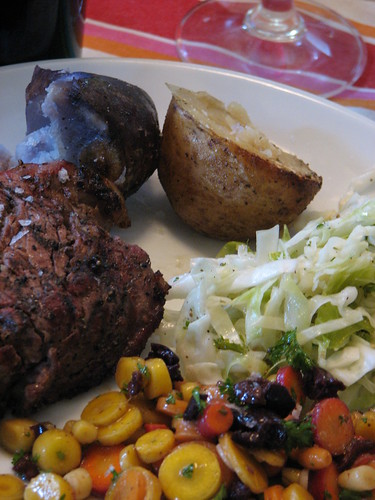 We shared our meal with Chef Boots and Dr. E, who came up for the day from Winston-Salem. Chef Boots didn't bring bread or dessert, which made me slightly sad, but he made up for it with the wine. Sorry, it wasn't local - on bottle was from California though! We chatted and relaxed and put together an impromptu afternoon feast. A few non-local ingredients were used, but they were already open in the fridge (and just where am I supposed to find North Carolina olives???) It may seem like we're in a rut, but it's a tasty one. Here's the Independence Day menu chez Little Creek.
Grilled Steak - from Virginia (which falls into our "traveling" category of local - it's grown in the county where we spend about a week a month working) - pastured about 5 miles from the worksite.
Cole Slaw - made with cabbage, onion and parsley from The Garden - 0 miles. (The oil, salt, pepper and celery seed were not local, but the vinegar is from NC)
Roasted Potatoes - The Garden - 0 miles.
Carrot Salad - made with carrots, shallots and parsley from The Garden - 0 miles. Olive oil and balsamic vinegar (Italy), calamata olives (Greece), salt and pepper were not local.
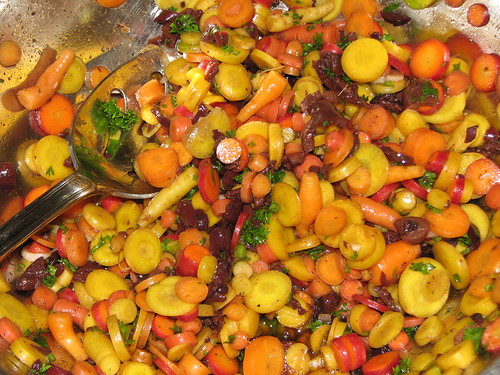 The carrot salad was amazing - beautiful, simple, satisfying and intense. I plan on making a lunch of the leftovers today. The carrots were so sweet that the last thing they needed were traditional raisins (or as Chef Boots likes to add, dried cherries) We tried some calamata olives and a savory basalmic viniagrette, which Charlie remembered from somewhere, and it was perfect. Since the baby carrots were really too small to shred like in a traditional carrot salad, Dr. E sliced them up, which left them crunchy and showed off their color. The viniagrette I made was simply a little organic olive oil, equal parts baslamic and white basalmic vinegars, sea salt and pepper. Mixed bites with the cole slaw were quite tasty and we thought next time we might combine the two.
We finished off the day watching fireworks in Black Mountain from the school's playground, with friends; our friend, Dave, picking the Star Spangled Banner on his guitar. Perfect.
Tuesday, July 03, 2007
Celebrating Local
The updates of week one of One Local Summer are up. It's so exciting to see everyone's meals from all over the country (and out of the country too). I spent last evening perusing various entries. I'm getting lots of ideas. It looks like I'll have new blogs to read. Now I just have to find the time.
In the garden I've pulled out the onions. They are small this year, but have good flavor. They are curing now. Charlie has bought lumber to start construction on the root cellar under the porch. This year we won't have to store potatoes under our bed! I've planted more haricot verts, golden wax and Roma beans. I like the Romas for canning. I've also started to fill in where we've dug potatoes. I'm planting cow peas and black eyed peas in those spots. I may not get much of a later crop, but they make a good cover crop and can be left on top of the row over the winter. I've somehow managed to squeeze in lots of garden work in lately. Now if only we'd get some real rain...
Eating locally and gardening go hand in hand. We are finally getting to the time of year when we can go out to the garden and pick dinner. The tailgate market has been a giant boon to the whole process. We've met neighbors that we haven't had a chance to meet in the three years we've lived here. There are many more like-minded people in this valley than I expected and it makes me hopeful that we'll never have subdivisions popping up. There's seems to be a genuine concern to keep this area agricultural and natural. We've also found lots of things we can't grow ourselves - beef, pork, sweet corn. Last night Monkey and I (Charlie was up in Virginia) ate an almost entirely local veggie meal of black-eyed peas and rice, early sweet (very sweet) corn from the co-op in Old Fort, and salad from the garden. The only non-local items were salad dressing, butter and the rice. That's not our "official" OLS meal this week, mind you. We're planning that for later in the week...
Saturday, June 30, 2007

Wednesday, June 27, 2007
Dichotomies
Living on a farm, even a small one like ours, is a life filled with dichotomies. There's the joy of catching fireflies each evening. Monkey runs across the lawn squealing with joy as she captures floating balls of light. She is allowed to keep the jar overnight. It sits on a shelf in her room, nature's nightlight. When she wakes up, she runs outside barefoot on the dew-soaked lawn and opens the lid to free her source of joy. It's a summer cycle that starts over each evening as the sun drops behind the mountain and edges of the forest grow dark.
There's joy in harvest; in finding the first tomato of summer - a small round Stupice - a perfect little fruit.
Then there's heartache. Lots of heartache. Two freezes in spring destroyed the fruit crops. Drought has hindered the blackberry and raspberry crop (although the smaller fruits that are ripening are quite sweet). Losing an animal is the roughest. We've lost so many this spring - over 20, to predators. There's the financial loss, the promise of eggs and meat lost and the loss of hours of care put into raising them. Anyone who's raised chicks from hatch or day-old chicks will know what I mean.
So, I should feel joy when I catch the predators, right? For an instant yesterday morning there was elation when I saw the two live traps had caught a full-grown racoon and a juvenile possum and then this morning an adult possum. But then there's the need to "dispose" of those wild creatures and it's heartache time again. I know the necessity of the action, but it still doesn't stop me from regretting the act. I cried yesterday morning and today. Tonight the poultry will be locked up safe and tight, but the traps will not be set. My soul needs a break.
Monday, June 25, 2007
One Local Summer 16.24.07

Liz's One Local Summer Challenge has started. Here's our first meal:
Grilled Filet Mignon - Foothills Family Farms, Old Fort, NC - 23 miles
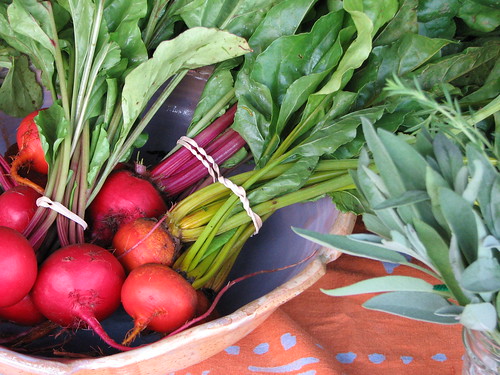
Fire-Roasted Potatoes (All Blue and Green Mountain), Carrots (Cosmic Purple, Amarillo Yellow, Atomic Red and Thumbelina), Onions, Chiogga Beets - The Garden - 0 mile
Shiva I.P.A.- Asheville Pizza & Brewing Company, Asheville, NC - 10 miles
A perfect meal to end a day of work in the garden and yard.
Sunday, June 24, 2007
Tailgate Market
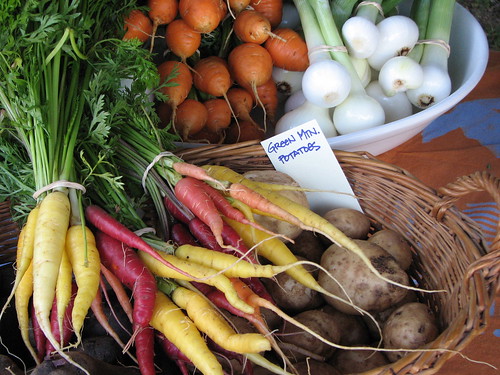
Our little local tailgate market is booming. It's so much fun to pack everything up and head down to the fire station on Saturday morning. Local small and hobby farmers are selling their produce and wares. People are stopping by and buying things. We've developed a following for eggs and late arrivals were sad to find we were sold out.
We sold out of everything but a pound of white potatoes yesterday. The exciting part was that we had a couple of chefs and caterers seperately stop by and they loved our market and, in particular, our produce. Two are supposed to call and talk about growing for or selling to them. I think for that to happen though we'd need more land.
In the garden, everything is growing despite the drought. We have been carefully watering. I need to get in there today and attack the potato beetles. The Japanese beetles have arrived and I'll have to set up a few traps. The chickens will love that!
Speaking of traps. The first night of trapping - nothing. Last night one bantam hen and two guinea keets would not come in despite our best efforts (when they fly high up in the beech or crawl under the chicken coop, it's impossible to lure them or catch them). There was only one keet outside this morning. She had flown high up in the beech. I'm so frustrated I could scream. The bait had been eaten out of the trap. So again tonight we'll be setting traps and locking up birds. The geese are not very happy with having to spend the night with the chickens. I've been telling them that once the new goat barn is built, they can have a fancy stall next to the goats.
Friday, June 22, 2007
I'm mad, I'm sad, I vow revenge!
We've lost quite a few chickens to a night-time maruader. Everyone that was taken was outside of a pen at night. Last night the mangler got crafty. We lost one of the guinea cocks, who was in the large enclosed pen and two lavender guinea keets and Lazarus in their own enclosed pen. The large pen is attached to the chicken house with the door open. No one in the chicken house was injured or killed. My guess is 3 geese guarding the door would make it hard for anyone to get in. While there is a spot on top of the large pen where an animal might get in, the little coop is completely enclosed with 2-inch woven fencing. I have no idea what got them. I'm extremely sad about Lazarus - she had survived so much. This morning I was so disgusted and discouraged, that I wanted to get rid of them all. I feel like I've let them down. I thought they were all safe in their pens. Raising animals is painful sometimes.
Here's what my conversation at Tractor Supply sounded like today:
Me: "Excuse me, could you help me get that live trap down off the top shelf?"
Harry, the sales clerk: "Sure. Do you have a critter problem?"
Me: "Yes. Something's been getting my chickens."
Here's where we go in to long discussion of fencing, what the kill looks like, where we live...
Harry: "It could be a skunk or coon. I've had the same problem. I set out a trap.
First night - nothing, second night - all the bait was gone, third night there was
a big racoon." And then he added, "It's better to find a coon than a skunk in a trap." (I'm not looking forward to either...)
I'll keep you posted on what, if anything, turns up in the trap. I don't particularly like the idea of a trap. I've lost a few chickens in the past to predators, (mostly neighbor dogs) and figure that's just what will happen from time to time. But now I'm at close to a 20 animal loss and I don't want to lose anymore. Tonight all feathered creatures will be locked in the chicken house and the traps will be set. The wild beasty must go!
Thursday, June 21, 2007
One Local Summer
This coming Sunday marks the beginning of Liz's One Local Summer. Interest has grown so much since it's creation last year that she had to close off the participants at 100. Way to go Liz! I'm making our local area the Carolina's - both North and South, but I'm hoping to keep it pretty close to home. I'm very excited with the market and all this year. I've found a lot of local sources in the last year.
We will be traveling some during the challenge this year, so wherever we go I'm going to try to have one local meal per place. Last year, that seemed to work well. There was a Missouri meal and a Carolina Coast meal.
Participating in OLS and in the Eat Local Challenge has helped open my eyes to all the wonderful things grown in my area. I've also made a lot of friends along the way in my journey to self-sufficiency and protection of local small farms. This Saturday is the tailgate market's Summer Celebration. I hope to have a lovely meal next week prepared with ingredients from our own garden and the gardens and farms of our neighbors and friends.
Wednesday, June 20, 2007
Keets gone wild
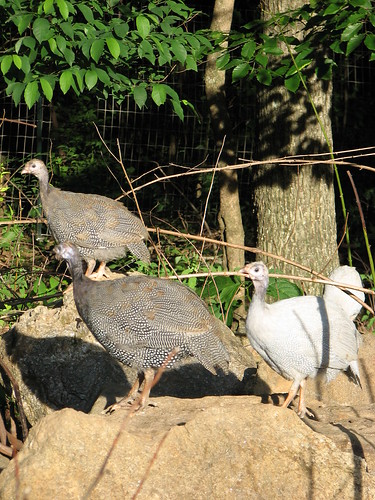 The keets enjoy some sunshine on their first day out of their pen. Like good little birds they went back into their pen at night.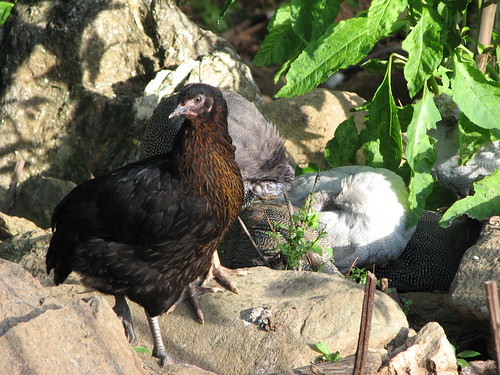
Lazarus, the miracle chicken thinks she is a guinea hen. She's almost all grown up. I keep hoping she's a she. I promise I will tell her story one day soon.
Hi Ho, Hi Ho
It's off to the new job today. This will be day two. Yesterday was quite entertaining. I've gone to work for Charlie. When he started his own consulting and design firm last September, the last thing I thought I would do is go to work for him. But really it only makes some sense, as my name is on all the bank papers; it's my company too!
So, here's the backstory: Charlie left the design/build world of landscaping and went off to consult with and design for the big, bad wolf developers. His goal was to convince them that sustainable development was not only good for the environment, but good for their pocket books (that's how you convince them that limiting the amount of disturbance to the land is good for them). Luckily he came across several clients that were like-minded. He's pushing organic methods for home-sites and vast tracks of undisturbed land for the enjoyment of all. He now has projects in Virginia and North Carolina, working mainly with preserve and resort developments. We have upcoming projects in New Hampshire, the NC Coast and Florida. He had asked several times this past winter if I wanted to come work for him and I always said "no", fearing I would become an office manager or secretary. While I hold no disdain for these jobs, I think I've made it clear over the last several months that I cannot sit in an office or at a desk all day. So when Charlie proposed that I take over a lot of the field work, I thought, "Yes, I can do and would enjoy doing that!"
Yesterday I spent my day on site, meeting the managers of vast acreages, driving over very scary roads up and down mountains, and talking to a couple of guys from the NC Wildlife Commission about reestablishing and protecting native brook trout. Today I'm off to look at more property holdings and meet more people. I'm sort of hitting the ground running and it's very exciting.
The perks of this job are that I only have to work three days a week (which gives me lots of time in the garden), I get a hip office downtown and the work environment is ever-changing. I also get to buy a bunch of new clothes! My summer wardrobe has been limited to dirty, torn shorts and old t-shirts. Now I need nice, neat outdoorsy clothes. All those cute skirts for school are just going to have to hang in the closet.
Monday, June 18, 2007
It's good to be home
A week away from home is difficult. It's extremely difficult with 38 chickens, 3 geese, 4 ducks, 3 turkeys, 11 guinea hens, 2 goats, 2 dogs, a cat and a fish. Oh, and don't forget the garden and all the new shrubbery we've planted.
Luckily, we had the world's best pet sitter, who just happens to be one of Monkey's teachers. She is also 8 months pregnant. How she did it I'll never know, but almost everyone was healthy and happy when we returned. I say "almost everyone" because we had a mystery attack on the young cockerels and pullets. Out of 16, there is now only one Salmon Faverolle rooster. I think the youngsters must not have gone into the chicken coop at night and something (most likely a raccoon or possum) picked them off over several nights. We had planned on butchering the roosters when we got home. I don't have the heart to kill the survivor now. Carly had warned us that she had found one eaten chicken carcass; it turned out to be more than that. She felt terrible when she realized how many had disappeared, but there was really little she could have done. In fact, the first year we had chickens, I lost all but 8 when I went inside for a few minutes and left them unnattended in the yard. Birds can be hard...
Tonight I made sure everyone was in their respective coops and hopefully we won't lose anymore.
And in the garden...
Everything is growing! We've finally pulled out the last of the peas and put sweet potatoes in their place. It's the first year for sweet potatoes in the garden. Beans are coming up, as well as okra, cow peas and cucumbers. I was really jealous when I saw the size of my sister-in-law's tomatoes in Missouri. Of course, they've had rain and heat. Our last frost was mid-May and we finally had nights above 55 degrees in early June. And I would like a little rain please...
Oh, and I'm very excited to participate once again in Liz's One Local Summer!
Wednesday, June 13, 2007
On the road
We are on vacation. We've come to Mid-Missouri for my nephew's first birthday. I've been relaxing as much as possible with a five year old and her grandparents. It can be daunting. Tomorrow we are heading up to our old neighborhood to visit this. I can't wait to visit the new expansion. As a student, I spent many hours in the basement looking at paintings that the public rarely saw. There was no room to display all the work. I've waited a long time for this.
I also plan to chow on Vietnamese food. It's the single greatest thing that I miss from city-living (next to weekly visits to the art museum down the street, of course).
I'm planning on seeing to very close friends tonight and then my dear, dear friend is arriving from Switzerland tomorrow and another is coming in from New York. We are having a little reunion Friday night and I just can't wait.
I would be posting exciting photos, but I left my camera cord back in North Carolina. Oh well, now that I'm free from the daily desk job, I'll have more time to post things when I get home. I may just have a review from the museum tomorrow. It depends on how tired I am.
I hope the goats are behaving for their sitter!
Thursday, June 07, 2007
How life should be
It is much more satisfying to go to bed physically exhausted than mentally and emotionally exhausted. I collapsed into bed last night, sore and happy. I spent the day in the garden. I finally got to weed and mulch three aisles that were out of control. That took most of the morning and my compost bin is filled with the weeds.
I despise untidiness in the garden. I love overabundant chaos, but the designer in me needs tidy aisles for plants to spill over. I prepared the remaining unplanted beds. I also planted roma beans, haricot verts, yellow wax beans, okra, crooked neck yellow squash and two types of zucchini (not to mention dozens of sunflowers and marigolds). I wish I had planted them two weeks ago, but my time was not under my control.
More cutting flowers and herb plants will go in this afternoon. I also h0pe to get the watermelon plants, pumpkin and vining squash in the ground today.
We've started planning the rebuilding of the greenhouse. This time instead of a kit, we are going to build it from scratch. We found a nice-looking design a couple of weeks ago. The materials should cost around the same as the kit Charlie got me for Christmas and it should be sturdier (besides, we can adjust it to suit our needs). I'm keeping my fingers crossed that we'll have time to build it before the end of summer. I want tomatoes through the fall. I want lettuce all winter. I want my greenhouse back!
Agatha Grunker is feeling much better. Her discomfort doesn't seem to have taught her anything. I caught her trying to find a way into the chicken house yesterday. She's a naughty goat.
Tuesday, June 05, 2007
Return to the land of the living
The last day of school was last Friday. I'm beginning to feel like a real person again. I've had time to drink coffee and linger in the garden in the morning. Feeding the animals is a time to relish, not to hurry. I also have time to plan for the market on Saturday. I'll be cutting flowers, pulling onions, clipping herbs and cleaning eggs on Friday instead of Saturday morning.
Agatha Grunker got her little goat-self into the chicken coop on Sunday and gorged herself on layer pellets. It's not an understatement to say that she's feeling well under the weather. She has perked up a little today. I'm limiting food to a nice hay and water. Keep your fingers crossed. I think she'll be o.k. in a day or two.
Sunday, June 03, 2007
To market to market
Yesterday was the first day of our community's tailgate market. It was so much fun. There's not too much to sell just yet - lots of greens, lettuce, radishes and onions. There were a few beautiful beets. Our Little Creek Farm table sold out of spring onions and eggs. It was much busier than expected. All of the vendors had expected a very slow start, but word had gotten out and the neighbors turned out in force to by fresh produce. I can't wait until next week.
We finally have cooler temperatures and a little rain. I'm hoping to get some more things in the ground today. Something is eating my lettuce and the tops of radishes as they come up. I have a sneaking suspicion that it's rabbits. Dang them. I'm going to have to stake Biscuit the Wonder Dog out there to catch the varmits...
Wednesday, May 30, 2007
Simple Things
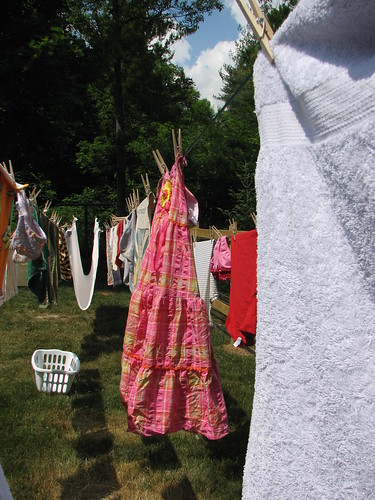
I have the belief that things can be improved through small, simple steps. Our newest small step has been to add a clothesline and limit use of the dryer. We serendipitously received the posts from a friend (I had been searching for months) and Charlie installed the line over the long weekend. Monkey even likes to help fold the clothes. We are constantly doing loads of laundry, so without doing any scientific research, I'm sure we'll save on electricity (and give a tiny little back to the environment).
We're already thinking of our next little step to make our home a better place to live.
Only three more days of school. I really can't wait.
Friday, May 18, 2007
I got the blues
This little bluebird house has been empty for 3 years. It sits on a post on the edge of the garden. Each spring birds come and check it out, get my hopes up, and never move in. This year they have. And last night, while thinning carrots I heard little peeps. Below is mother bird waiting for me to get myself out of her way so she can deliver the goods to the kids inside.
Monday, May 14, 2007
Just a short hiatus
Things are hectic with the end of school and all. The garden and chicks are growing. The ducks and geese are practically grown. And tomorrow is the Monkey's fifth birthday. We'll be back in full swing soon. Only 15 more school days and I'm a free woman! I'll be back soon.
Subscribe to:
Posts (Atom)