Showing posts with label green acres. Show all posts

Monday, March 17, 2008

Peach Blossoms


peach blossom, originally uploaded by maggies farm.

The first of the fruit trees has burst forth. Our little Saturn peach opened up some of its blooms yesterday. Saturn peaches are supposed to be frost hardy. Let's hope so. They bloom very early (earlier than the cherries). I planted it last spring. It survived the terrible hard freeze and drought of last year. The plum was not so lucky... If all goes well, we may be rewarded with some lovely flat, white peaches this summer.

The blossoms are beautiful.

Sunday, March 09, 2008

trout lily


trout lily, originally uploaded by maggies farm.

I took a walk in the woods today with Gigi and Bill the Cat. Bill the Cat loves to go on walks in the woods. Gigi has taken to leaving her balls and frisbees along the trails. I told her I'm not carrying them home, but she pays little attention to me. She's sort of a rock star right now. She and I were on the news last night and today because we gave an agility demonstration at the Nature Center yesterday afternoon.

Anyway...
We found the first bloom of spring over by the upper spring. Later we found more down below the waterfall on the creek. I say "we", but of course I mean "me". Gigi was too busy loosing her toys and Bill was too busy climbing trees and leaping over logs.

Tuesday, November 27, 2007

To lawn or not to lawn...


grass, originally uploaded by maggiesfarm.

Driving to my hometown took us across the vast wasteland of monoculture that I'll refer to simply as Illinois. I could add Missouri and Kentucky to this as well, but in my experience, Illinois seems to take the cake in the world of vast swaths of single crops. Just take a drive on Interstates 70 or 64 and see what I mean. This made me think again of a topic I thought to write about, the lawn - America's favorite monocrop.

The concept of lawn didn't really exist for most Americans until the industrial age. Before then very few could afford the upkeep of a lawn cut by hand. The mowed lawn has it's origin in France and England. Before the invention of the lawnmower, it was mowed by hand or kept short by grazing sheep, cattle and even rabbits. In our time, 58 million Americans spend over $30 billion every year to maintain 23 million acres of lawn. 30 to 60 percent of urban water is used for lawn care. 67 million pounds of synthetic fertilizer are used to keep that turf happy. You see, our modern turf grasses come from other climates. They are basically exotics in the wrong environment, so we spend lots of energy and water trying to keep them green and happy.

As many of us have faced drought this year and most likely next year as well, it would be a good thing to reconsider the lawn (if you haven't already done so). It would be a good thing to consider it even if there wasn't a drought. In full disclosure, we have a rather large lawn. We didn't plant it. We don't water it. What we basically do is mow it. With the drought this year, we mowed rarely and it went dormant for a long period of time. Grass will do that, you don't need to water so much. I promise.

The lawn is slowly shrinking as we increase garden space and beds and fence it in for pasture. It is used as pasture - the geese and ducks are out on it almost every day one of us is home. How much lawn space do you need? Turf grass does make an excellent surface for play. However, beds for flowers and ornamental shrubs are much more interesting than grass. They conserve water, create attractive space for wildlife (especially our little feathered friends), and can easily require less care than turf grass.

Lawns don't have to be grass! Depending on your climate, a lawn can be composed of various ground covers (some are invasive, so check before you plant), moss, and a mixture of plants. Ours is a mixture of pasture grasses, clover, and various other things that pop up. I can't say enough about clover. Bees love it. We love bees. After the horrible late freeze and storms that wiped out our apples, blueberries and greenhouse this spring, beekeepers were asking people not to mow their lawns so that the honey bees could find sustenance in clover. We were more than happy to oblige.

So that's the introduction. Next up - Water Conservation.

I need to get back to the work I get paid for. And, the first of the seed catalogs has arrived - Pinetree Garden Seeds. I've got to start perusing.

Wednesday, October 24, 2007

Rain

We've had rain the last couple of days - most of it has been light and sporadic, but it's rain. There's a little over an inch in the rain gauge and perhaps more to come. The good news is that it seemed to rain heavier a little to the south of us - which could be good news for the Georgia lakes, which are so low.

If you haven't heard, Atlanta (a rather large city) has only 90 days of water left. There has finally been lots of discussion about water management processes. My only hope is that water management and city planners and citizens will take a good long look at long standing practices and change. My fear is that those planners and citizens will get over this crisis and go back to living like they always have. On a recent trip down to Georgia, I heard one person complain that they hadn't been able to go boating this summer. That was their biggest concern. How about drinking? Hmm.
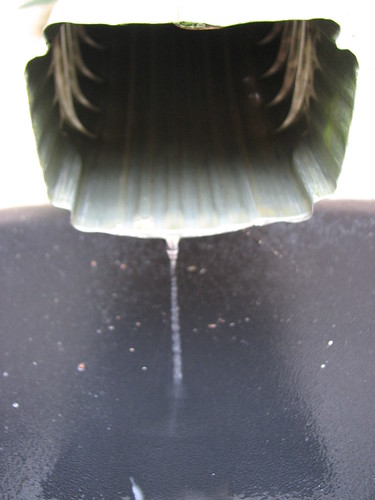

rain barrel

But on to the topic I planned to start with - rain barrels. I love our rain barrel and we are adding more (the plan is one to every corner, for all the beds surrounding the house). We don't have a huge problem with water runoff waste out here in the middle of nowhere. Generally it all comes from the roof, but there is a lot off the roof that we could use on our plants. The best way to gather that water is with rain barrels. If I had the budget to retrofit our house right now, I'd add a large cistern under the porch to gather all the rain water off of our roof. For now the barrel is doing well. We bought ours through a local non-profit and paid a little less than retail. Looking at the barrel, it would be easy to make your own - I've seen many versions. Here's one with directions for a rain garden as well! Rain gardens are a whole other topic. I'll just say I love them and they are a great spot to grow incredible plants.

Our rain barrel will fill with about a 1/4 to 1/2 inch of rain - that's 65 gallons of water off of one small side of our roof. We've used ours to water the vegetable garden in the past, but this year I concentrated on using it to keep a bunch of young hydrangeas alive. And it worked. I placed a soaker hose on the spigot and let gravity force the water to slowly and conservatively water them. All are doing well. I don't think they would have survived without it. I put a pretty tight restriction on watering ornamentals over the summer, prefering to limit watering to the things we eat.

If you don't have a rain barrel or two, I encourage you to build or buy your own. Make it a project for the winter. You'll be able to use it in the spring to water all those seedlings.